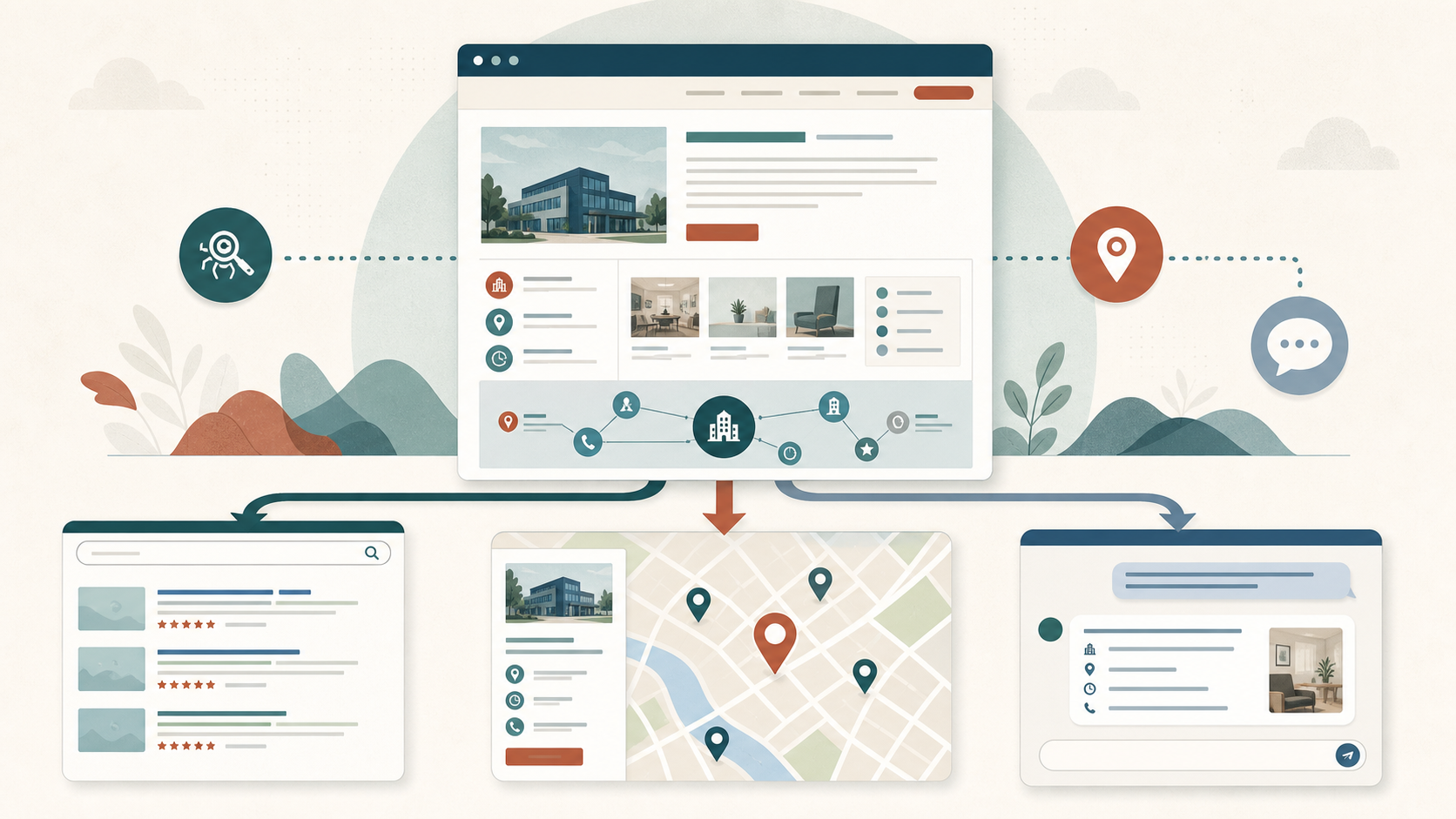
AI-assisted discovery changes how an answer may be assembled, but it does not make sound SEO obsolete. Search systems still need accessible pages, clear facts, useful answers and evidence that a business is what it claims to be.
Make important business information explicit, consistent, crawlable and supported by first-hand evidence. No optimisation method can guarantee that an AI system will mention or recommend a business.
How AI-assisted discovery differs
A conventional results page presents links for a user to evaluate. An AI-assisted interface may synthesise an answer, cite selected sources or continue through follow-up questions. This can reduce clicks for simple queries while increasing the value of being a trusted source.
The exact behaviour varies by product and changes over time. Build durable information rather than chasing one interface.
What remains unchanged from SEO
Search systems must discover and process pages. Descriptive titles, logical internal links, accessible HTML, useful content, technical reliability and external reputation continue to matter. Google’s public guidance says there are no special AI features or files required to appear in its AI search experiences beyond established search fundamentals.
Avoid treating “GEO” as a guaranteed placement service. It is a useful label for improving clarity and evidence, not a mechanism that controls model output.
Establish a clear business identity
State the legal or trading name, services, locations, contact details and relevant people consistently. Create focused pages for important services and questions rather than relying on vague homepage claims.
Structured data can help describe entities and page types when it matches visible content. It is supporting markup, not a substitute for a clear page or real-world credibility.
Publish precise answers and original evidence
Define terms, explain process, compare options honestly and answer the questions customers actually ask. Use headings and short, quotable statements where they improve readability. Do not fragment one useful explanation into many thin pages.
First-hand project experience, original images, data, named methods and transparent limitations give a source something distinctive to contribute. Verify facts and keep time-sensitive material current.
Keep content accessible and consistent
Important information should appear in crawlable server-rendered HTML where practical, not only inside an interaction or image. Use alt text, captions and transcripts to make non-text content understandable.
Keep company details consistent across the website, business listings, industry directories and credible third-party references. Correct contradictions at the source rather than attempting to overwhelm them with repetition.
Measure AI referrals and mentions carefully
Analytics may identify some referrals from conversational tools, but apps, privacy controls and changing interfaces make measurement incomplete. Track referral sources, landing pages, branded searches and customer-reported discovery.
Monitor whether assistants can accurately describe the business using public information, but do not simulate a live AI query unless a real service is connected. Record errors and improve the underlying sources.
AI visibility preview
Before an assistant could confidently describe a business, it would need clear public answers to these questions:
- What is the business called and where does it operate?
- Which specific services or products does it provide?
- Who is each service for—and not for?
- What evidence shows experience and credibility?
- How does the process work and what are the trade-offs?
- How can a customer take the next step?
Search your own site for each answer. If a human cannot find it quickly, improve the source before worrying about a new optimisation label.
Frequently asked questions
Is traditional SEO dead because of AI search?
No. AI-assisted interfaces can change how answers appear and may reduce some clicks, but they still depend on discoverable information, relevance and credible sources. Good technical access, clear pages and real reputation remain foundational. Businesses should adapt measurement without abandoning useful search fundamentals.
What is generative engine optimisation?
It is a label for improving how information can be understood and potentially used in generative answers. Useful practices include precise facts, structured pages, first-hand evidence and consistent entity information. It does not provide a technical switch or guarantee that a model will cite a page.
Does a website need a special AI file?
Do not adopt a new file merely because a vendor claims it guarantees visibility. Follow documented crawler controls and the guidance of each platform. Google’s public guidance says established SEO fundamentals apply to its AI search experiences, without special AI markup requirements.
Should content be written in question-and-answer format?
Use Q&A where it helps a reader, not as a mechanical tactic. Clear definitions and direct answers can be easy to understand and quote, but substantial topics also need explanation, evidence and context. Page design should serve the user’s task.
How can AI-search referrals be measured?
Analytics may reveal some referring domains, while customer surveys, branded search trends and CRM notes provide additional evidence. Measurement will be incomplete as interfaces and privacy controls change. Track direction over time and avoid attributing every brand mention to one optimisation action.
Can schema markup make an assistant recommend a business?
No. Valid structured data can clarify entities and page content when it matches what users see. It does not create reputation or force inclusion. Use supported types accurately, validate implementation and focus on the underlying business facts and evidence.
A sensible next step
Tin Shed can review the technical access, entity information, page structure and original evidence that support both conventional and AI-assisted discovery.
Make your website understandable to search engines and AI systems
Prepared by Tin Shed Software as practical general information. Any AI-assisted workflow should be reviewed for accuracy, privacy, security and suitability before it affects customers or business decisions.