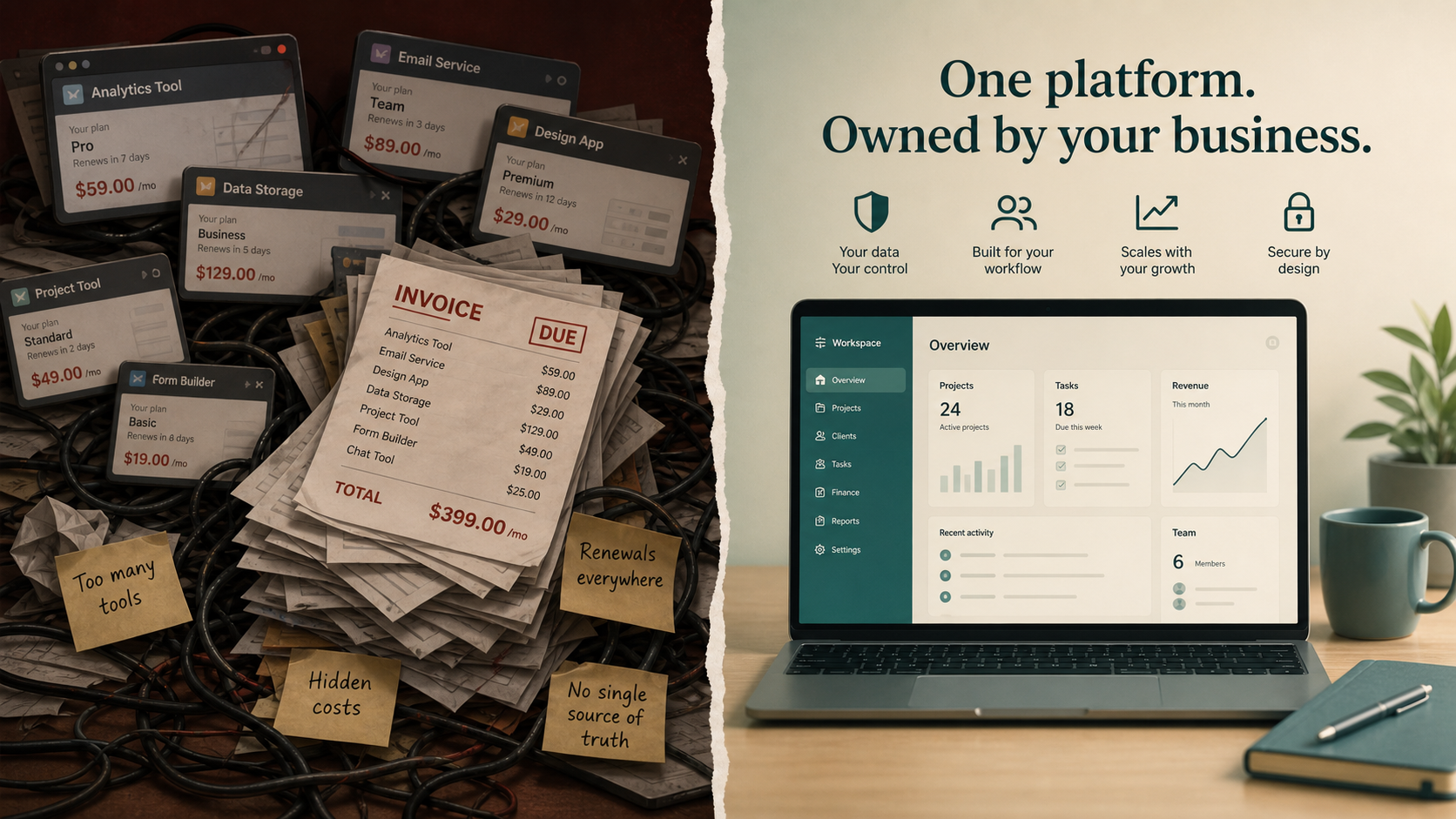
SaaS is often the fastest and lowest-risk way to adopt a mature capability. Custom software begins to make commercial sense when the workflow is strategically important, the compromises are expensive and the business is prepared to own a product over time.
Do not compare one monthly subscription with one build quote. Compare realistic three-to-five-year operating costs, constraints, migration risk and the value of a better workflow.
Why SaaS became the default
Subscription products spread development and support costs across many customers. They can provide mature features, updates, security work and quick deployment without a capital project. For standard functions such as email or accounting, this is difficult to beat.
SaaS remains right when the workflow is common, switching is practical, integrations are adequate and adapting the business is cheaper than building.
Signs the business may have outgrown it
Warning signs include paying for unused features, restricting access because of per-seat charges, maintaining spreadsheets around the “main” system, using several subscriptions for one workflow, and repeatedly retyping data because integrations or exports are limited.
Another sign is strategic differentiation. If the workflow is central to how the business serves customers and off-the-shelf software prevents improvement, ownership may create value beyond licence savings.
Calculate the real comparison
For SaaS, include seats, expected price changes, add-ons, integrations, administration, duplicated products, workaround time and eventual exit. For custom software, include discovery, design, development, testing, migration, hosting, monitoring, security, support and future improvement.
Model at least three years and test different user-growth and maintenance assumptions. Treat staff time as a cost only where the workflow genuinely consumes capacity that could be used elsewhere.
Build, buy or hybrid
Buy when the capability is standard. Build when workflow ownership creates durable value and requirements are understood. Hybrid when reliable services can handle commodity functions while custom software coordinates the distinctive workflow.
Hybrid is common: a business-owned platform may integrate payment, email, identity or mapping services rather than recreating them. Ownership should focus on the parts that matter.
Migration without disruption
Inventory data, integrations, reports, users and contractual exit conditions before development. Run migration rehearsals, reconcile samples and preserve an auditable fallback. Decide how long the old system remains available and who signs off each data set.
Clarify code ownership, hosting access, backups, security response, documentation, support and the process for future changes. Owning software means owning decisions and operating responsibilities as well as source code.
Build-versus-buy decision prompts
| Question | Points toward SaaS | Points toward ownership |
|---|---|---|
| Is the workflow standard? | Mostly | Distinctive and strategic |
| Are workarounds material? | Minor | Frequent and costly |
| Can data move freely? | Good APIs and exports | Persistent restrictions |
| Can you operate software? | No internal appetite | Clear owner and budget |
Frequently asked questions
Is custom software always cheaper than SaaS?
No. SaaS is often much cheaper for standard capabilities because many customers share development and operating costs. Custom software is commercially plausible when the workflow has strategic value, subscription and workaround costs are substantial, and the business can support the product over time.
What does owning custom software actually mean?
Ownership should be defined in the contract: source code, intellectual property, data, domains, cloud accounts, documentation and deployment access. It also means responsibility for hosting, security, backups, support and future decisions. Code ownership without operational control can still leave the business dependent.
Can a business replace only part of its SaaS stack?
Yes, and that is often the sensible route. Keep commodity services that work well and build a focused platform around the distinctive workflow. A hybrid design can integrate payments, email, identity or accounting while the business owns the orchestration, data model and customer experience that create advantage.
How accurate does the build estimate need to be?
Early estimates should be ranges with explicit assumptions. Discovery reduces uncertainty by mapping workflows, data, integrations, migration and non-functional needs. A fixed number before those facts are understood may include a large hidden contingency or create pressure to omit necessary work.
How can migration risk be reduced?
Inventory and sample the data early, agree mapping and reconciliation rules, rehearse migration, preserve audit records and operate a fallback. Train users with real scenarios. Migration is part of the product, not an administrative task left until launch week.
What if the SaaS vendor improves its product during the build?
Review the decision at planned checkpoints. If the vendor removes the key constraints at an acceptable cost, continuing a build merely to justify sunk effort is unwise. A modular discovery and delivery approach allows the business to adapt as market options change.
A sensible next step
Tin Shed can help build a fair comparison using your actual subscriptions, workaround hours, integration limits, user growth and expected system life.
Prepared by Tin Shed Software as practical general information. Any AI-assisted workflow should be reviewed for accuracy, privacy, security and suitability before it affects customers or business decisions.