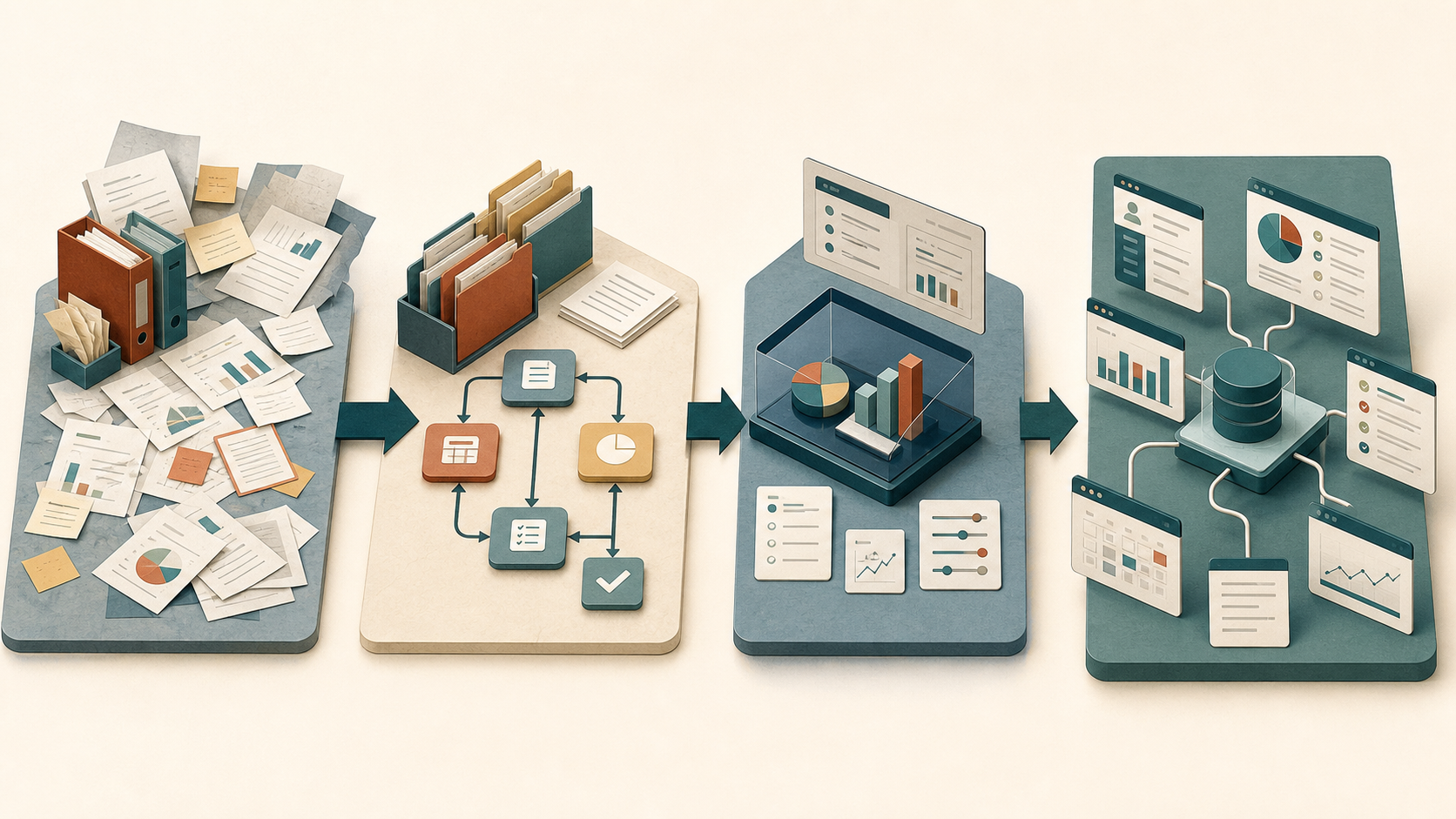
Being ready for AI is less about owning the newest software and more about knowing what the business is trying to improve. Clear processes, trustworthy information, ownership and controlled decisions matter before model selection.
If a workflow is unclear without AI, it will usually become more confusing with AI. Readiness work should make the operation better even if the pilot never proceeds.
What “AI ready” means
An AI-ready business can define a problem, provide approved information, connect the relevant systems, control access, review outputs and measure the result. It does not need perfect data or a company-wide strategy. It needs enough clarity to run one safe, useful experiment.
Readiness is specific to a workflow. A business may be pilot-ready for internal document search but only exploring AI-assisted pricing because the latter carries greater commercial risk.
1–4: problem, process and information
1. Is the problem clearly defined? State the delay, cost, error or customer frustration—not “we need AI”. 2. Is the workflow documented? Capture triggers, steps, exceptions and hand-offs. 3. Is the source information accessible? Identify the system or documents the output should rely on. 4. Is the data sufficiently accurate? Sample it and record known gaps rather than assuming cleanliness.
5–8: integration, ownership and risk
5. Can existing software be integrated? Check APIs, exports, permissions and vendor limits. 6. Who owns the AI system? Name a business owner, not only a technical contact. 7. Which decisions require human approval? Make approval explicit in the design. 8. What sensitive data is involved? Classify personal, confidential, financial and operational information before testing.
9–12: control, success and scale
9. How will access be controlled? Users should see only the information their role permits. 10. How will success be measured? Use time, accuracy, completion, customer experience or cost. 11. Can the business run a small pilot? Limit users and consequences. 12. Can the result be maintained? Budget for source updates, monitoring, support and review.
Four readiness levels
Exploring means the opportunity is interesting but the workflow or information is unclear. Prepared means the process and risks are understood. Pilot-ready adds reliable inputs, ownership, controls and measures. Scale-ready means the pilot has evidence, integration and an operating model.
A low score is useful. It tells you whether to document work, fix information, clarify responsibility or reduce scope before investing in a build.
12-point AI readiness check
Tick each statement that is already true.
Frequently asked questions
What score means a business is ready for AI?
There is no universal pass mark. The assessment shows which foundations exist for a particular workflow. A low-risk internal drafting tool may proceed with fewer controls than a system affecting customers, staff or money. Treat the level as a conversation starter and examine every unticked item that could cause harm or unreliable results.
Does data need to be perfect?
No, but the business must understand important weaknesses. Sample the information, record missing fields and identify conflicting sources. A pilot can sometimes help expose quality problems. It should not hide them behind fluent output. High-impact decisions require stronger evidence, testing and traceability than low-consequence assistance.
Who should own an AI pilot?
A business owner should be accountable for the workflow and outcome, supported by technical, privacy, security and subject experts as needed. Leaving ownership solely with a vendor or IT team creates a gap: they may operate the system but cannot decide whether it is correct, fair or useful in the business context.
What if existing software has no API?
Check supported exports, webhooks and vendor integration options before resorting to brittle screen automation. A small manual transfer may be acceptable during discovery, but it changes the expected benefit. If reliable integration is impossible, the business may need to reduce scope, change products or decide the workflow is not ready.
How long should an AI readiness review take?
A focused workflow can often be assessed in a few workshops plus source and risk checks. Company-wide inventories take longer and can become abstract. Start with one concrete example, follow the information and decisions end to end, and record unknowns. The purpose is a decision and next-step checklist, not a large report.
Can a business be ready for one use and not another?
Yes. Readiness belongs to a workflow, not a brand. A company may be ready for internal knowledge search but unprepared for automated customer advice. The data, decisions, users, integrations and consequences differ. Assess each proposed use on its own merits while reusing governance practices across the organisation.
A sensible next step
Bring the assessment result and the workflow you have in mind. A short review can expose the strongest first step and the risks that need design work.
Prepared by Tin Shed Software as practical general information. Any AI-assisted workflow should be reviewed for accuracy, privacy, security and suitability before it affects customers or business decisions.